Quick Answer
VCT floor waxing in Austin means stripping the old acrylic finish off vinyl composition tile, deep-cleaning the tile, then laying four to six thin coats of new finish and burnishing it to gloss. Texas Sparkle Services does it overnight for Austin offices, clinics, retail and schools. Measured written quote: (512) 919-9810.
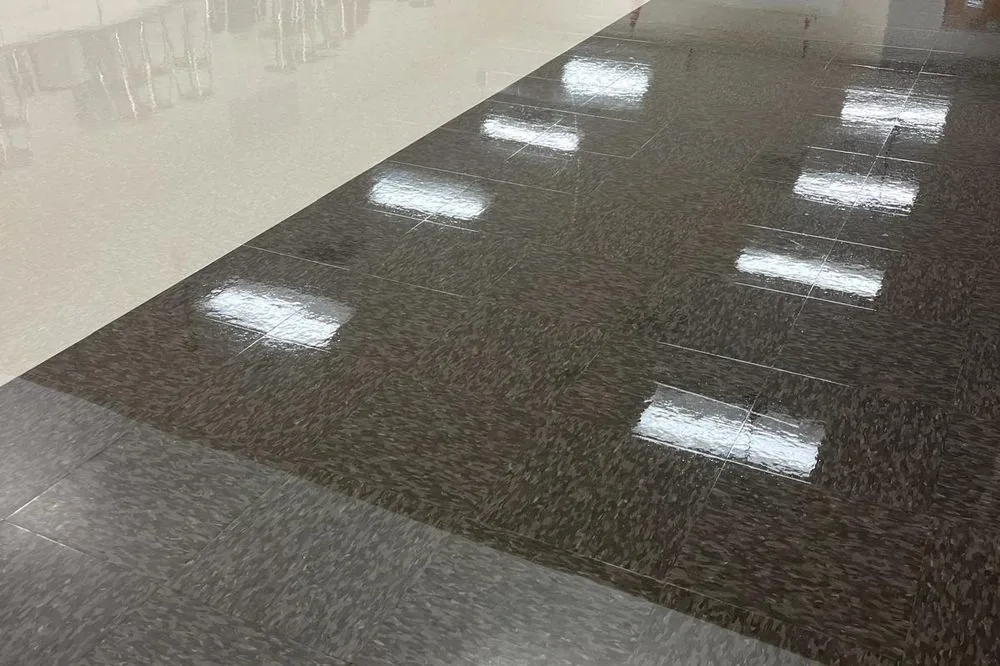
Texas Sparkle Services strips, waxes, burnishes and deep-cleans commercial VCT floors across Austin, Texas. Floor work is the part of commercial cleaning where the difference between a good contractor and a cheap one is visible from across the room for the next two years. Get the chemistry, the pad and the coat count right and a twenty-year-old vinyl floor looks new. Get them wrong and you have haze, streaks, powdering finish or stripped-out grout lines that nobody can fix without starting over.
This page covers Austin specifically. For the region-wide program see floor care, stripping and waxing across Central Texas, or the full list of cleaning services we provide in Austin.
What VCT Floor Waxing Actually Involves
"Waxing" is a holdover term — modern commercial floor finish is an acrylic polymer, not wax. What matters is that there are three distinct jobs, they cost very different amounts, and most floors do not need the most expensive one:
Strip and Wax — The Full Reset
Every layer of old finish comes off with a stripping solution and a low-speed machine, the slurry is picked up wet, the tile is neutralised and rinsed so no residue remains, and then new finish goes down in thin, even coats. Coat count is the lever: four coats for a low-traffic office, five to six for corridors, entries and retail. Each coat has to dry properly before the next, which is why a strip-and-wax is an overnight job rather than an afternoon one.
Scrub and Recoat — The Middle Option
If the finish is worn but still bonded and free of black marks down to the tile, we machine-scrub the top layers off, then apply one or two fresh coats. It restores most of the appearance at a fraction of the cost and disruption, and doing it on schedule is how you stretch a full strip out to two years or more.
Burnish and Buff — The Maintenance
High-speed burnishing heats and re-levels finish that is already sound, bringing back gloss without any chemical stripping. Monthly or quarterly burnishing on a maintained floor is the cheapest floor-care money a facility manager can spend.
VCT Tile Cleaning Without Stripping
Some Austin floors are not dull because the finish has failed — they are dull because soil has built up in the tile texture and grout lines. A deep machine scrub with the right pad and a neutral cleaner, followed by a burnish, brings those back without touching the finish system at all. We check for this before quoting a strip, because it saves clients real money.
Why Austin Floors Wear the Way They Do
Two local factors show up on nearly every Austin floor we assess.
Limestone and construction dust. Central Texas sits on limestone, and the metro has been under continuous construction for years. The fine pale grit that gets tracked into every Austin lobby is mildly abrasive — it acts like a very light sandpaper underfoot, cutting gloss out of traffic lanes far faster than ordinary indoor soil would. This is why entry matting and a burnishing schedule matter more here than in a wetter, less dusty climate.
Humidity and cure time. Floor finish cures by water evaporating out of the film. In Austin's humid stretches, coats take noticeably longer to dry, and rushing the next coat onto a film that has not released its water is exactly how finish ends up cloudy or soft. We plan coat timing around actual conditions on the night rather than a fixed clock, which occasionally means a five-coat job becomes a two-night job. We would rather tell you that up front than hand back a hazy floor.
Austin Facilities We Do Floor Work For
- Offices and multi-tenant buildings — corridors, elevator lobbies, break rooms and restroom floors in the downtown, North Austin and Domain corridors
- Medical and dental practices — clinic corridors and waiting areas, coordinated with our medical office cleaning in Austin so floor work does not collide with patient hours
- Retail and showrooms — sales floors and stockrooms, scheduled around trading days
- Schools, daycares and churches — classrooms, fellowship halls and gyms during breaks and between programs
- Warehouses and flex space — office areas and break rooms inside industrial buildings, alongside warehouse cleaning
- Restaurants and food service — back-of-house and dining-room hard floors, including tile and grout
- Gyms and fitness studios — hard-floor areas around equipment and in locker rooms
Recommended Floor-Care Intervals in Austin
These are the cycles we most often set for Austin clients. Traffic volume, entry design and whether matting is in place move them more than anything else.
| Facility / Area | Burnish | Scrub & Recoat | Full Strip & Wax |
|---|---|---|---|
| Office corridors & break rooms | Monthly | Every 6–12 months | Every 18–24 months |
| Building entries & lobbies | Weekly to monthly | Every 4–6 months | Every 12 months |
| Medical & dental corridors | Monthly | Every 6 months | Every 12–18 months |
| Retail sales floors | Weekly | Every 3–6 months | Every 12 months |
| School classrooms | Quarterly | Winter break | Every summer |
| Church fellowship halls | Quarterly | Every 12 months | Every 24 months |
| Warehouse office & break areas | Quarterly | Every 12 months | Every 24 months |
Our guide on how often commercial floors should be stripped and waxed goes into how to read a floor and decide which of the three services it actually needs.
How VCT Waxing Is Priced in Austin
Floor work is quoted per square foot, and the price per foot moves on five things: which service (burnish, scrub-and-recoat or full strip), the number of finish coats, how much old finish and adhesive residue has to come off, how much furniture and fixture moving is involved, and whether we are working overnight in an occupied building with sectioning and signage.
We do not quote floors over the phone. The condition of the existing finish is most of the cost, and it cannot be described accurately by a client who is not looking at it with a scraper in hand. We measure the area, test a small patch to see how the existing finish releases, and put a written price and coat count in the quote. For how commercial cleaning rates get built generally, see our office and commercial cleaning cost per square foot guide.
Quick Facts
- Service: VCT stripping, waxing, scrub-and-recoat, burnishing and tile deep cleaning in Austin, TX
- Floor types: VCT, LVT / vinyl plank, sheet vinyl, terrazzo, sealed concrete, ceramic tile & grout, commercial rubber
- Scheduling: Overnight, weekends and holiday closures; sectioned work in occupied buildings
- Typical coats: 4 for low traffic, 5–6 for corridors, entries and retail
- Cure: Light foot traffic within hours; keep carts and casters off 24–48 hours
- Phone: (512) 919-9810 | Email: info@txsparkleservice.com
- Pricing: Per square foot, quoted in writing after measurement and a test patch
Our Austin Floor-Care Process
- Assessment and test patch — we identify the flooring material, check how the existing finish releases, measure the area and note furniture, thresholds and drains.
- Written scope — service type, coat count, square footage, schedule and access, priced in writing.
- Protection and prep — furniture moved or masked, baseboards protected, wet-floor signage and sectioning agreed with building management.
- Strip or scrub — solution applied at the correct dilution and dwell, machine-worked, slurry picked up wet, floor neutralised and rinsed.
- Finish — thin, even coats with proper dry time between each; edges cut in by hand.
- Burnish and inspection — gloss brought up, floor walked with you, furniture reset.
Related Services for Austin Facilities
- Commercial carpet cleaning — hot-water extraction for the carpeted half of the same building.
- Office & janitorial services — the recurring program that keeps a new finish looking new.
- Pressure washing — entries, sidewalks and dumpster pads, where most of the tracked-in grit starts.
- Post-construction cleaning in Austin — first clean and initial finish on brand-new VCT after a build-out.
- Commercial cleaning — the full facility program across Central Texas.
- Church cleaning in Austin — fellowship-hall and gym floors between programs.
Floor Care Elsewhere in Central Texas
- Floor stripping & waxing in San Antonio, TX
- Floor stripping & waxing in New Braunfels, TX
- Floor stripping & waxing in San Marcos, TX
VCT Tile Cleaning in Austin: Daily and Weekly Care
Waxing is what people search for, but most of a VCT floor's life is decided by the cleaning that happens between waxes. A floor that gets stripped and refinished twice a year still looks tired by month three if the daily care is wrong. This is the routine we set up for Austin offices, clinics, schools and shops:
- Dust mop or vacuum every day. Grit is what scratches floor finish. Austin's limestone dust and the sand that blows in from parking lots act like fine sandpaper under shoes
- Damp mop with a neutral cleaner. Floor finish is designed to be removed by high-pH (alkaline) stripper, so a strong degreaser or an all-purpose cleaner used for daily mopping slowly softens and dulls it. A neutral-pH floor cleaner at the right dilution cleans without eating the finish
- Auto-scrubber on larger floors. Warehouses, school corridors and big retail floors are scrubbed with a ride-on or walk-behind machine that cleans and picks up the dirty water in one pass, instead of spreading it with a mop
- Burnish on a schedule. High-speed burnishing heats and smooths the top layer of finish and brings the gloss back. Traffic lanes, entries and checkouts get it most often
- Walk-off mats at every entrance. Most of the soil on a commercial floor comes in on shoes in the first few steps. Long enough mats at the door cut the cleaning load on the whole floor
- Spot-treat black heel marks before they are buffed into the finish, where they need a full scrub to come out
VCT or LVT? Check Before Anyone Strips Your Floor
Many Austin buildings have both: original vinyl composition tile (VCT) in back rooms and corridors and newer luxury vinyl tile or plank (LVT/LVP) in the renovated spaces. They are cleaned differently, and treating LVT like VCT can damage it.
| VCT | LVT / LVP | |
|---|---|---|
| What it looks like | Usually 12×12 inch tiles, flecked or solid colors, color runs all the way through the tile | Planks or tiles printed to look like wood or stone, often with beveled edges |
| Surface protection | Needs floor finish (wax); raw VCT is porous and dull | Factory wear layer, usually with a urethane coating |
| Stripping | Routine, every one to two years in most buildings | Most manufacturers advise against conventional stripping; follow the manufacturer's care guide |
| Day-to-day care | Dust mop, neutral cleaner, burnishing | Dust mop, neutral cleaner; burnishing only if the manufacturer allows it |
If you are not sure which one you have, we check at the walkthrough before quoting. A chipped corner is the easiest tell: VCT shows the same color all the way through, while LVT shows a printed top layer over a different-colored core.
Signs Your VCT Needs a Strip and Wax, Not Just a Buff
- Gray, dull paths in the traffic lanes where the finish has worn through to bare tile
- A yellow or brown cast, usually old finish that has trapped dirt layer over layer
- Black marks that do not come out with a scrub because they are sealed inside the finish
- Finish that powders or flakes along the walls and under desks
- Burnishing no longer brings the shine back, or it lasts only a few days
If only the top layer is scuffed, a scrub and recoat is usually enough and costs less. If dirt is sealed between layers or the finish is worn through, only a full strip and wax fixes it. For the region-wide program see floor care, stripping and waxing across Central Texas.
Frequently Asked Questions
How much does VCT floor waxing cost in Austin?
VCT stripping and waxing in Austin is priced per square foot, and the range depends on the number of finish coats, how much old finish has to come off, how much furniture we move, and whether the work has to happen overnight in an occupied building. A scrub-and-recoat costs materially less per square foot than a full strip-and-wax because it skips the stripping stage. We measure the floor and quote in writing after a walkthrough — no phone estimates for floor work, because the condition of the existing finish is the whole job.
What is the difference between stripping, waxing and buffing?
Stripping chemically removes every layer of old floor finish down to the bare tile. Waxing (properly, applying finish) puts new acrylic finish back on in thin coats, usually four to six. Buffing or burnishing uses a high-speed machine to bring gloss back to finish that is already there and still sound. Stripping is the reset, waxing is the rebuild, burnishing is the maintenance — and doing the third often lets you delay the first by a year or more.
How long does VCT waxing take and when can we walk on it?
For a typical Austin office or clinic suite, a strip-and-wax runs one overnight for a few thousand square feet. Each coat needs roughly 30–45 minutes to dry before the next, so coat count drives the timeline more than area does. Light foot traffic is normally fine a few hours after the last coat; we ask you to keep rolling carts, chair casters and heavy furniture off for 24–48 hours so the finish can cure fully.
Can you wax floors after hours so our business stays open?
Yes — that is how nearly all of it gets done. We work nights, weekends and holiday closures, and in occupied buildings we can section the floor so only part of it is closed at a time. Retail and clinic clients usually schedule around their weakest trading day.
How often should VCT be stripped and waxed in Central Texas?
Most Austin commercial floors do well on a full strip-and-wax every 12–24 months, with scrub-and-recoat and regular burnishing in between. High-traffic entries and corridors sit at the short end of that range because Central Texas limestone and construction dust are abrasive and grind gloss off faster than indoor-only soil would.
Do you clean VCT tile as well as wax it?
Yes. VCT tile cleaning on its own — deep scrubbing the tile and grout lines without stripping the finish — is a service we do routinely for floors that are dull from soil rather than from worn finish. Often a deep scrub and a burnish is all a floor needs, and it costs a fraction of a strip-and-wax.
What floor types do you work on besides VCT?
We work on VCT, LVT and wood-look vinyl plank, sheet vinyl, polished and sealed concrete, terrazzo, ceramic and porcelain tile with grout, and commercial rubber. Each takes a different chemical and pad, and the wrong combination is how floors get permanently hazed — so we confirm the material before we quote.
How do I keep VCT tile clean between waxes?
Dust mop daily, damp mop with a neutral-pH floor cleaner rather than a degreaser, keep walk-off mats at the entrances, and burnish traffic lanes on a schedule. Strong alkaline cleaners soften floor finish, so they shorten the time between strip-and-wax jobs.
Can LVT or luxury vinyl plank be waxed like VCT?
Usually not in the same way. LVT has a factory wear layer, and most manufacturers advise against conventional stripping. We check which floor you have at the walkthrough and follow the manufacturer's care guide for LVT.